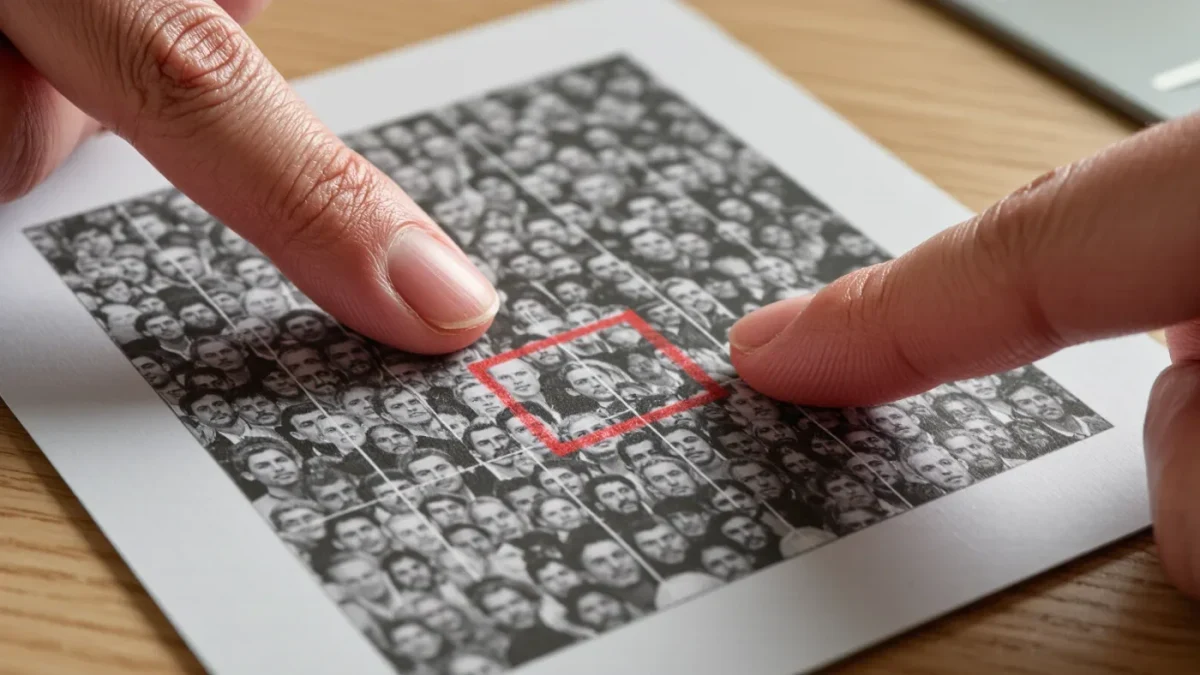
The U.S. National Park Service stopped issuing official crowd estimates in 1995 after its numbers for the Million Man March were publicly disputed — a confirmed, dated policy change that still stands. That is the cleanest demonstration available: when the agency with aerial photographs and professional staff will not count crowds, neither can a caption. Every number in a crowd fight should carry a source, and the source is the story.
The fights are permanent because the method is honest but limited. Here is what actually produces the numbers.
How are crowd sizes actually estimated?
Density times area. Counters divide the space into grid zones, assign each zone a density — loosely packed, packed, jammed — and multiply. Modern efforts overlay photos on maps or count heads in sample squares and extrapolate. The method is standard and transparent. Its weakness is equally standard: small errors in density propagate across a huge area, so a defensible range is the only defensible output. A single precise number is already a red flag.
Why do honest counts disagree?
Because three inputs vary. Which area counts — only the packed core, or the spillover streets? What density applies — and density visibly differs between the front of a crowd and the back? And at what moment — crowds peak and drain, so two honest photos taken ninety minutes apart can support different numbers by tens of thousands. None of these choices is a lie. All of them together explain why organizers, police and academics routinely land far apart while each being defensible.
What was the 2017 inauguration dispute about?
Photos, not just politics. Side-by-side aerial images of the 2017 National Mall inauguration crowd and the 2009 crowd, published and widely analyzed by outlets including the BBC, showed visibly different densities, while the new administration asserted the largest audience ever — a claim contradicted by the visual record and by Washington-area transit data reported at the time. Confirmed: the photos, the claim, the contradiction. The incident became the modern template for crowd-number fights.
How do photos themselves mislead?
Through angle and timing. A low, tight shot from the front makes a modest crowd look enormous; a high wide shot from behind the stage empties it. Zoom compression stacks distant heads into solid mass. And photos from the peak hour get compared against photos from before gates opened. Reverse angle — literally — is the cure: the same crowd from two directions at one timestamp, against a map. If a viral claim rests on one angle, it rests on nothing.
Who can you believe on a crowd number?
Ranked by method disclosure: academic estimation teams that publish their density assumptions; official agencies that release imagery alongside figures — and agencies, remember, may decline to estimate at all, as the Park Service has since 1995; organizers, whose incentives run one direction; and anonymous captions, whose numbers are unconfirmed by definition. The right question is never 'how many?' but 'counted by whom, over what area, at what time?' Any answer without those three parts is decoration.
What happened with the Million Man March estimate?
The dispute that ended official estimates. In 1995 the National Park Service put the Washington crowd at roughly 400,000; organizers rejected the figure, and a Boston University research team using aerial imagery later produced an estimate near 870,000 with a stated margin of error. Two professional counts, same event, a gap of hundreds of thousands, both defended with published methods. Confirmed: the dispute, the figures, the aftermath — the Park Service withdrew from the estimating business soon after. That outcome is the lesson in one line: a crowd number is a method with a signature, not a fact with an owner.
What should you do with a crowd claim?
Strip it to the ledger. Confirmed: the event happened, and any photo with a verifiable time and place. Unconfirmed: every round number in a caption without a named counter. False: only when a specific figure is contradicted by a specific record — a transit count, a dated aerial comparison. Crowds are measurable; virality is not a measurement. When two people shout numbers at a photo, the photo agrees with both of them, and with neither.
For more context, read How to trace a viral claim to its original source.
For more context, read Trace a viral photo's origin with reverse image search.
For more context, read Anatomy of a celebrity apology video.